
The Million-Dollar Misunderstanding About Your IRA
Your IRA statement shows what you saved, not what you'll keep. See why taxes change the real value of that balance & how to plan for it before you retire.


A few years ago, I had a couple sit right across from me to talk about their retirement. They weren't unusual in any dramatic way, they worked hard, raised a family, lived within their means, and spent more than thirty years doing what every financial professional tells people to do.
Every payday they contributed to their retirement accounts. They stayed invested through good markets and even through the bad ones. They resisted the temptation to chase hot investments or abandon their plan even when the headlines became a bit frightening.
Like many PG&E employees approaching retirement, they weren't searching for a miracle. All they wanted to know was whether their years of discipline had even been enough.
After a few minutes into the meeting, the husband slid a retirement account statement across the table. He tapped the number at the bottom of the page with a smile that reflected their decades of hard work and sacrifice.
"$2.1 million," he said. "I think we're finally going to be okay."
I smiled back because well, he was right to be proud. Building a retirement portfolio of that size doesn't happen because of luck. It took thousands of ordinary decisions made over many years. It was choosing to save instead of spending, continuing to invest when everyone else is panicking, and understanding that wealth is usually built through quiet consistency over an entire lifetime.
Then I asked him a simple question, one that completely changed the direction of our conversation.
"How much of that $2.1 million do you think actually belongs to you?"
He looked at me for a second, laughed, and glanced back at the statement.
"All of it... I hope."
I reached for a pen and wrote a single sentence across the top of his statement.
"Your IRA is an IOU to the IRS."
That phrase belongs to IRA expert Ed Slott, and I don't think anyone has explained traditional retirement accounts more clearly. The government gave you a tax deduction when you contributed the money. In exchange, it expects to collect its share when the money comes back out. Think of your IRA as a future tax obligation.
The smile disappeared, not because he had done anything wrong, but because no one had ever framed it that way to him before. For more than thirty years he had focused on growing the account balance, but never thought about what it would be worth after taxes, and that's the million-dollar misunderstanding.
Many PG&E employees know they will eventually pay taxes on their retirement accounts. Ask almost anyone if IRA withdrawals are taxable, and they'll answer correctly. The misunderstanding is psychological. We naturally begin thinking of the number on our statement as our money. After looking at that balance every month for twenty or thirty years, it becomes easy to forget that the government still has a claim on a big portion of it.
Imagine buying a rental property that produces wonderful income every year. You wouldn't ignore property taxes, maintenance, insurance, or repairs when deciding what the property is worth to you, those expenses are part of the ownership experience. Yet people routinely look at a million-dollar IRA and mentally spend every dollar, even though a meaningful portion may eventually be paid in taxes. The account statement tells you how much you've accumulated, but it doesn't tell you how much you'll ultimately keep.
That doesn't mean traditional retirement accounts are a mistake, it’s quite the opposite really. For many people, contributing to a traditional 401(k) during their highest earning years is one of the smartest financial decisions they can make. The upfront tax deduction may save thousands of dollars each year, and decades of tax-deferred growth can dramatically increase retirement savings. The problem is assuming that saving for retirement and planning for retirement are the same thing, when they aren’t.
Saving money is largely about accumulation, where retirement planning is all about coordination.
During your working years, financial success is driven by a handful of straightforward habits. Spend less than you earn, save consistently, stay invested, and ignore the noise that accompanies every market correction. Those principles aren't exciting, but they work because time has an extraordinary ability to reward disciplined behavior. Most successful investors don't outperform because they discover secret investments. They outperform because they continue doing ordinary things long enough to compound to produce extraordinary results.
But retirement starts to change the conversation.
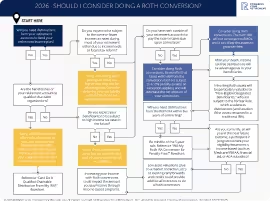
Once the paycheck stops, your financial life becomes less about growing assets and more about making more thoughtful decisions. Which account should you withdraw from first? When should you claim Social Security? Should you consider a Roth conversion? How much taxable income should you recognize each year? How might today's decisions affect Medicare premiums, Required Minimum Distributions, or the taxes paid by a surviving spouse years from now?
These questions rarely dominate the conversation while you're working, yet they often determine how much of your lifetime wealth your family actually keeps.
One of the greatest opportunities I see involves a period that many retirees unintentionally waste. Imagine someone retiring at age sixty-two but delaying Social Security until age seventy. Required Minimum Distributions are still years away. Their earned income has disappeared, yet many of the future sources of taxable income haven't even started yet.
Those years often represent the lowest tax brackets they will ever experience again. Unfortunately, they also become years when people hesitate because paying taxes voluntarily feels wrong.
That's understandable, we've spent our entire working lives trying to reduce taxes. We celebrate deductions, contribute to pre-tax retirement plans, postpone income whenever possible. Then retirement arrives, and suddenly one of the smartest decisions may involve intentionally recognizing income while tax rates are relatively low. It feels backwards, which is exactly why so many people struggle with the idea.
I sometimes tell clients, "If you're feeling especially patriotic and want to pay more taxes, don't do anything."
Everyone laughs, but then I explain that I’m only half joking.
Doing nothing feels safe because it doesn't require making a difficult decision, but doing nothing is still a decision. It's a decision to allow future tax law, Required Minimum Distributions, and the IRS to determine when your retirement savings become taxable. Sometimes that's perfectly appropriate. Other times it can start to cost a family tens or even hundreds of thousands of dollars over a thirty-year retirement.
One of the lessons I've learned after years of working with retirees is that the biggest financial mistakes usually come from good people making reasonable decisions without realizing the long-term consequences. That's true with investing, and it's equally true with taxes. Waiting often feels prudent, delaying difficult decisions feels responsible, and yet in retirement, the decision to wait can be every bit as significant as the decision to act.
This is why I encourage clients to think about taxes over their lifetime rather than focusing exclusively on this year's return.
Your tax return tells the story of last year, and your financial plan writes the story of the next thirty. Those are very different documents serving very different purposes.
When we prepare a tax return, we're documenting history. We record income that has already been earned and deductions that have already occurred. Retirement planning asks a different set of questions. Should you voluntarily convert part of your IRA to a Roth while you're in a lower tax bracket? Would delaying Social Security create greater flexibility later? How will future Required Minimum Distributions affect your tax situation? Could today's decision reduce taxes for a surviving spouse years from now? None of those questions can be answered by looking in the rearview mirror.
Of course, there is no universal solution. Every family brings different goals, different pensions, different investment accounts, different health concerns, and different estate planning objectives. Good planning is coordinating dozens of smaller decisions, so they support one another instead of creating unintended consequences. Retirement is less like solving a single math problem and more like conducting an orchestra. Each instrument matters on its own, but the real beauty comes from making them work together.
Perhaps that's the biggest lesson this couple took away from our meeting. They left understanding that retirement planning wasn't over simply because they had reached a certain account balance. In many ways, the most important planning decisions were still ahead of them.
PG&E employees can spend up to forty years learning how to save for retirement and almost no time learning how to spend it. Building wealth is an incredible accomplishment, but it's only half the journey. The other half is making thoughtful decisions that allow you to keep more of what you’ve got to spend.
So, the next time you look at your retirement account statement, take a moment to appreciate what it represents. It reflects years of discipline, sacrifice, patience, and good decisions. Then ask yourself one more question.
What is my plan for getting this money back out?
Because the number on your statement is the starting point for the next chapter. As Ed Slott reminds us, "Your IRA is an IOU to the IRS." The goal isn't to avoid paying taxes, it’s to avoid paying more than necessary.
Powering Your Retirement is a Registered Investment Advisor. Registration as an investment adviser does not imply a certain level of skill or training, and the content of this communication has not been approved or verified by the United States Securities and Exchange Commission or by any state securities authority. The information contained in this material is intended to provide general information about Powering Your Retirement and its services. It is not intended to offer investment advice. Investment advice will only be given after a client engages our services by executing the appropriate investment services agreement.
Useful Resources
You May Also Like,
Here are some must-read blogs you don’t want to miss! Get expert tips on retirement benefits, 401(k) management, and more. Stay in the know and make the most of your retirement planning!



Are You Ready for Retirement?
Book your free, no-strings-attached assessment—a stress-free process where we’ll tell you the exact amount you need to retire, when you want to!
