
The PG&E Employee Pension Calculator
Wondering what your PG&E pension could pay? Follow one example employee through the Union, Management & Cash Balance math, then see where your own plan lands.


If you work at PG&E, your pension could be one the the most valuable parts of your retirement package.
Unfortunately though, it can also be one of the most confusing.
Depending on when you were hired and whether you are union or management, you’ll fall under one of three main pension structures:
- Union Final Pay Pension
- Management Final Pay Pension
- Cash Balance Pension
All three of these are designed to give you retirement income, but they each calculate benefits very differently.
To make things easier to understand, we’ll use the same hypothetical employee all the way through this article.
Let’s assume the employee:
- Starts at PG&E at age 30
- Earns $100,000 in the first year
- Receives a 3% raise each year
- Works through age 62
- Has 32 years of service at age 62
By age 62, that annual salary has grown to roughly $257,508.
Keep in mind these are only examples. Your actual pension will depend on your pension records, eligible compensation, service history, retirement date, and payment option.
Oh, and by the way, the employee’s name is Mark.
Union Final Pay Pension
The Union Final Pay Pension is a traditional defined benefit pension. So, instead of building your account balance, PGE will use a formula to calculate a monthly pension.
For this example, the basic Union Final Pay formula is:
- 1.5% for the first 25 years of service
- 1.6% for years of service over 25
Mark has 32 years of service, so the math looks like this:
First 25 years:
25 × 1.5% = 37.5%
Next 7 years:
7 × 1.6% = 11.2%
Total pension percentage:
48.7%
Now apply that to final pensionable pay:
$257,508 × 48.7% = approximately $125,407 per year
Divide that by 12:
Approximately $10,451 per month
That’s the basic pension amount before considering any other adjustments.
Your monthly benefit can shift depending on when you start the pension and which payment option you select.
For example, if you elect a joint-and-survivor option so your spouse continues receiving income after your death, your monthly benefit will generally be lower than the single-life amount.
This is one of the conversations I have most often with married couples, and it tends to be more emotional than you’d expect. Seeing a smaller monthly number feels like a loss at first, but it looks very different once you frame it as what your spouse would be living on if you weren't around.
That's why getting an official pension estimate from PG&E matters a great deal.
Management Final Pay Pension
The Management Final Pay Pension works off an entirely different formula.
Instead of using only final pay, it generally uses the average of the employee’s final 36 months of eligible compensation.
The basic formula for this example is:
1.7% × Years of Service × Final Average Pay
Our employee has 32 years of service.
32 × 1.7% = 54.4%
The final three years of salary are approximately:
- Age 60: $242,726
- Age 61: $250,008
- Age 62: $257,508
The average is approximately:
$250,081
Now apply the pension percentage:
$250,081 × 54.4% = approximately $136,044 per year
Divide that by 12:
Approximately $11,337 per month
Again, this is the basic amount before any adjustments for retirement age, survivor benefits, or other plan provisions.
Union vs. Management Final Pay
Both Final Pay pensions are similar in that they’re traditional pensions, but the formulas are different.
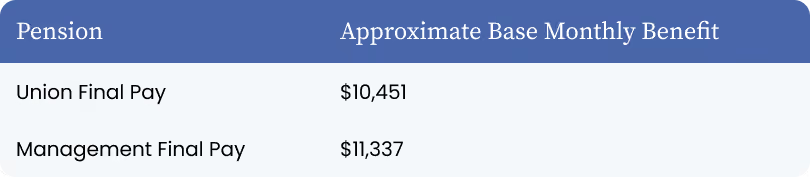
Looking at these side by side, it's tempting to crown the management plan the winner, and in this example it does come out ahead. For any one person though, the result usually depends on salary history, years of service, retirement age, and the plan rules that apply to them. The key takeaway is that the formulas are different, so two people with similar careers can land in different places.
The Cash Balance Pension
The Cash Balance Pension works very differently from the Final Pay pensions.
Instead of calculating a pension mainly from final salary and years of service, PG&E maintains a hypothetical account balance for you, and each year that account receives two things:
- A pay credit
- An interest credit
The pay credit percentage is based on a point system.
Your points are generally:
Age + Years of Service
The Cash Balance pay credit schedule is:
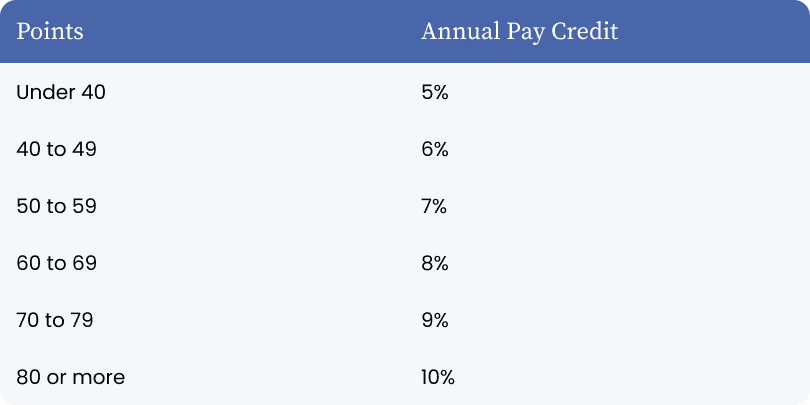
As you get older and accumulate more service, the percentage of pay credited to the pension generally increases.
A Note About the Change to Cash Balance
Let’s be clear here, these examples are meant to show how the different PG&E pension formulas work and what they could provide in retirement.
For eligible employees hired or rehired on or after January 1, 2013, the Final Pay Pension was no longer available and the Cash Balance Pension became the applicable pension plan. Certain existing employees were also given a one-time opportunity to move to the Cash Balance Pension beginning in 2014.
For a lot of PG&E employees, the pension you have was set by your hire date and the plan rules that apply to you. That's why I try to steer conversations about the change toward how the Cash Balance Pension works, since labeling it simply good or bad doesn't get you very far. It was designed in part to make the pension program more sustainable over time. It follows its own logic.
I’ve heard many employees express frustration that the newer pension isn’t as generous as the old Final Pay Pension, and I get it. When the coworker next to you was hired just a few years before you, it can sting a bit.
At the same time, many workers outside of PG&E don’t have a pension at all. Speaking for myself, and for many of the clients I work with who have no pension, there is still significant value in having a company-funded retirement benefit like the Cash Balance Pension.
How the Cash Balance Points Work
Mark starts at age 30 with zero years of service.
30 + 0 = 30 points
That puts the employee in the 5% credit range.
At age 35:
35 + 5 = 40 points
The credit rises to 6%.
At age 40:
40 + 10 = 50 points
The credit becomes 7%.
At age 45:
45 + 15 = 60 points
The credit becomes 8%.
At age 50:
50 + 20 = 70 points
The credit becomes 9%.
At age 55:
55 + 25 = 80 points
The credit reaches 10%.
Cash Balance Example
Let’s continue using Mark’s details again.
At age 30, salary is $100,000 and the pay credit is 5%.
$100,000 × 5% = $5,000
That $5,000 is credited to the Cash Balance account.
The next year, salary rises to $103,000.
The employee is still in the 5% range.
$103,000 × 5% = $5,150
The account also receives an interest credit.
For illustration, we’ll assume a constant 4% annual interest credit. The plan interest credit can differ, so 4% is only a planning assumption.
At age 31:
Beginning balance: $5,000
4% interest:
$5,000 × 4% = $200
New pay credit:
$5,150
Ending balance:
$5,000 + $200 + $5,150 = $10,350
This process continues every year.
As salary increases and the employee moves into higher point ranges, the annual credits get larger.
Using:
- $100,000 starting salary
- 3% annual raises
- The PG&E Cash Balance credit schedule
- A constant 4% annual interest assumption
the account grows to approximately:
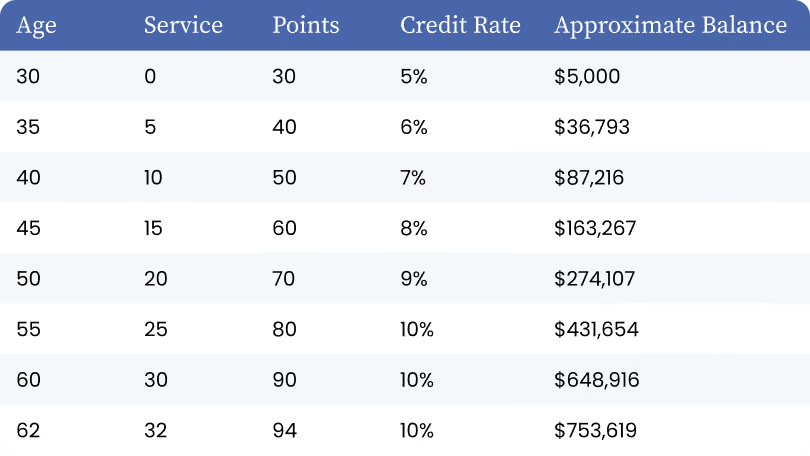
$753,619 at age 62
Here are a few points along the way:
Lump Sum or Monthly Pension?
One of the biggest differences with the Cash Balance Pension is that employees may generally have the ability to take the benefit as a lump sum or convert it into monthly lifetime income.
That opens up a whole new retirement decision. Do you take the lump sum and roll it into an IRA, or do you take the monthly pension?
There is no single answer that works for everyone.
The decision can depend on:
- Other guaranteed income
- Social Security
- Spouse’s income
- Investment assets
- Life expectancy
- Desire to leave money to heirs
- Interest rates
- Taxes
- Comfort managing investments
Someone with plenty of investment assets may value the guaranteed income, while someone else may prefer the flexibility of a lump sum.
Whichever way you go, make sure you understand what you're giving up and what you're getting in return.
Retirement Age Matters
It's easy to fixate on the formula and treat your retirement date as an afterthought. The date you retire, and the date you start your pension, can matter a lot too.
Working another year may give you:
- Another year of service
- A higher salary
- A higher final average pay
- Another Cash Balance pay credit
- Another interest credit
- Another year of 401(k) contributions and company match
Even a difference of a few months can affect more than just your final paycheck.
Pension and Social Security Should Be Looked at Together
Age 62 is also a milestone because it’s generally the earliest age you can begin Social Security retirement benefits.
Whether claiming at 62 makes sense for you is its own conversation, but turning 62 does mean several big retirement decisions may start landing at the same time.
You may be deciding:
- When to retire
- When to start the pension
- Whether to take a lump sum
- When to claim Social Security
- When to use the 401(k)
- Whether Roth conversions make sense
- How to pay for medical insurance before Medicare
These decisions shouldn’t be made separately, they all affect your retirement income and taxes.
Final Thought
The simplest way to think about the three pension plans is:
Union Final Pay Pension: Final pensionable pay and years of service drive the benefit.
Management Final Pay Pension: Final 36-month average pay and years of service drive the benefit.
Cash Balance Pension: Annual pay credits, age-plus-service points, and interest credits drive the benefit.
Before you choose a retirement date or pension option, get updated estimates from PG&E and compare more than one retirement date.
Then look at those estimates alongside Social Security, your 401(k), taxes, healthcare, and spending needs.
Your pension shouldn’t be viewed in isolation.
For many PG&E employees, the pension represents hundreds of thousands of dollars of retirement value, so it deserves to be planned right alongside everything else you've built. If you'd like a second set of eyes on your estimates, I'm always happy to walk through the numbers with you.
The examples in this article are simplified illustrations. Actual PG&E benefits are determined by the official plan documents and PG&E’s pension administrator. Employees should obtain official pension estimates before making retirement decisions.
Powering Your Retirement is a Registered Investment Advisor. Registration as an investment adviser does not imply a certain level of skill or training, and the content of this communication has not been approved or verified by the United States Securities and Exchange Commission or by any state securities authority. The information contained in this material is intended to provide general information about Powering Your Retirement and its services. It is not intended to offer investment advice. Investment advice will only be given after a client engages our services by executing the appropriate investment services agreement.
You May Also Like,
Here are some must-read blogs you don’t want to miss! Get expert tips on retirement benefits, 401(k) management, and more. Stay in the know and make the most of your retirement planning!


Are You Ready for Retirement?
Book your free, no-strings-attached assessment—a stress-free process where we’ll tell you the exact amount you need to retire, when you want to!
