
Trump Accounts Aren’t A Children's Savings Account
Don't let the name put you off. See how a Trump Account can jumpstart your child's retirement decades before their first paycheck, built for PG&E families.

When PG&E employees first hear about Trump Accounts, some immediately focus on the name.
“I don’t like Trump.”
“I don’t want an account with his name on it.”
“I’m not participating in anything connected to him.”
The problem with this is that it’s an emotional response, and not a financial decision
You don’t have to support Donald Trump, vote for him, or like him to recognize a potentially valuable financial opportunity for your children or grandchildren.The name “Trump” on the account doesn’t determine how much it may eventually be worth. The tax rules, contribution limits, investment returns, and amount of time the money remains invested will ultimately determine that.
Rejecting an account solely because of the politician whose name just happens to be attached to it could mean turning down a ton of government money, employer contributions, decades of tax-deferred growth, and a possible path to millions of dollars of retirement savings.
Your children or grandchildren's future is too important of a decision to make based on mere political emotions.
This Is Not Really a Children’s Savings Account
You'll often hear Trump accounts described as savings accounts for children. However, that description doesn’t tell the whole story.
A Trump Account is a new type of traditional individual retirement account established for a child. The child does not need wages, self-employment income, or other earned income for family members to contribute during the account’s special growth period.
Now, that’s a pretty big difference from how a normal IRA works.
PG&E employees are already used to structured, employer-shaped retirement vehicles like the pension and 401(k) match. So, really, a Trump account works on a similar logic, just starting decades earlier.
Normally, a child must have earned income before money can be contributed to an IRA on the child’s behalf. A 10-year-old who earns $2,000 mowing lawns might be able to contribute up to $2,000 to an IRA. A 10-year-old with no earned income generally cannot contribute anything at all.
So naturally, a Trump Account changes that during childhood.
Parents, grandparents, relatives, friends, employers, governments, and certain charitable organizations may contribute, subject to the applicable rules and limits. For 2026 and 2027, regular contributions are generally limited to a combined $5,000 per child each year. Now it probably goes without saying, but the child does not need $5,000 of earned income to receive that contribution.
This makes Trump accounts much better than simply a place to save birthday money.
The Most Valuable Asset Is Not the $1,000
Certain children born from January 1, 2025, through December 31, 2028, may qualify for a one-time $1,000 federal contribution after an authorized person makes the required election.
This is super valuable, and eligible families shouldn't easily pass on the opportunity.
But the biggest opportunity by a mile is time.
A newborn has roughly six decades before reaching a traditional retirement age. Very few, like practically no adults, begin retirement saving with that much time available.
A ton of people don’t begin seriously funding retirement accounts until their 30s, 40s, or even their 50s. Trump Accounts give children the opportunity to get a head start before they even reach kindergarten.
The government contribution may open the door, but regular family contributions and long-term compounding are what could make the account meaningful.
What Could $5,000 a Year Become?
Let’s suppose a family contributes $5,000 per year for 18 years.
The family would contribute a total of $90,000, not counting the initial government contribution, employer contributions, charitable deposits, or investment growth.
At a hypothetical 7% annual return, $5,000 contributed at the end of each year for 18 years could grow to approximately $170,000. Adding an initial $1,000 contribution would increase that amount slightly.
But all of that is only an illustration. Market returns will not arrive in a straight line, and no particular return is promised.
Even if the account is worth only $100,000 at age 18, the child could already have a meaningful retirement foundation.
Using the Rule of 72, an investment earning an average of approximately 7.2% would double about every 10 years. If a child had $100,000 invested at age 18 and never contributed another dollar, the illustration could look like this:
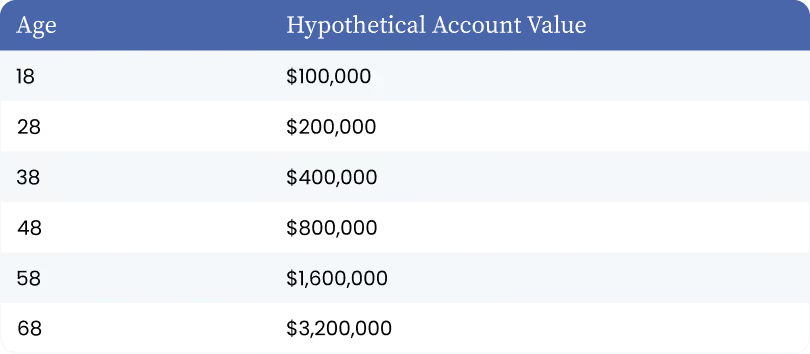
This is not a forecast or a guarantee. Actual returns, expenses, taxes, withdrawals, and investment decisions would change the result.
The illustration simply demonstrates what a long period of compounding can accomplish.
It also assumes the child leaves the account alone, invests it responsibly, and resists spending the money early. This is likely the biggest risk in the whole plan.
The account can provide the opportunity, but it cannot provide maturity, discipline, or good judgment.
The Child’s Behavior Will Matter
Beginning in the calendar year the child turns 18, a Trump Account is generally treated like a traditional IRA. Normal IRA tax and withdrawal rules then begin to apply.
That doesn’tt mean an 18-year-old can withdraw all the money without consequences.
A taxable withdrawal from a traditional IRA before age 59½ may be subject to ordinary income taxes and an additional 10% early-distribution penalty unless an exception applies.
Certain exceptions may be available for expenses such as higher education or a first home. However, avoiding the 10% penalty does not necessarily make the withdrawal tax-free.
This is why I tend to view a Trump Account as a retirement account that happens to start during childhood, rather than a college account, a first-car account, or a general spending account.
The best outcome may be for the child to leave the money invested, continue contributing as an adult, and allow it to grow for another 40 or 50 years.
A family that funds one of these accounts should also educate the child about its purpose. Handing an 18-year-old a six-figure account without years of financial education could undermine everything the family worked hard to build.
The investment account and the financial education should grow together.
The Roth Conversion Advantage
Could the money eventually become tax-free? It's possible, but it definitely won't happen on its own.
A Trump Account is generally treated as a traditional IRA after the childhood growth period. That means future earnings are tax-deferred rather than automatically tax-free.
However, the child may later be able to convert some or all of the account to a Roth IRA.
A Roth conversion moves money from the traditional IRA structure into a Roth IRA. The taxable portion of the conversion is usually included in the child’s income for that year. Once the money is inside the Roth IRA, future qualified withdrawals may be tax-free.
A young adult may have several years when income is relatively low. Those years might include college, graduate school, an internship, the beginning of a career, or time between school and full-time employment.
Converting portions of the account during lower-income years could allow the child to pay tax at relatively low rates and then potentially enjoy decades of tax-free Roth growth.
It’s worth saying that this takes planning rather than thinking of it as an automatic strategy.
Be Careful With College-Age Roth Conversions
It’s rather tempting to assume that an 18-year-old college student will automatically land in the lowest tax bracket.
But that may not be true.
The kiddie-tax rules can apply to certain children with unearned income. For 2025, Form 8615 may be required when a qualifying child has more than $2,700 of unearned income. The rules can apply to children under age 18, certain 18-year-olds, and full-time students under age 24 who do not provide more than half of their own support through earned income.
Taxable retirement income and Roth conversion income both require careful analysis under these rules.
On top of that, Trump Account contributions made by family members are generally nondeductible. That may create tax basis in the account, meaning a portion of a future conversion may not be taxable. Other amounts, including investment earnings and some third-party contributions, may receive different treatment.
Which is why the records will matter.
A large conversion should not be completed simply because the child turned 18. The family should first determine:
- How much of the account represents after-tax basis
- How much of the conversion would be taxable
- Whether the kiddie tax applies
- Whether the child is claimed as a dependent
- Whether the conversion affects financial-aid calculations
- Whether state income tax applies
- Whether spreading the conversion across several years would produce a better result
The best conversion window may occur during college, after graduation, or even when the child is financially independent but still earning a modest income.
The opportunity there is real, but the timing part should be planned
Do Not Confuse Politics With Planning
Getting back into the political ends of things, every financial law comes from politicians.
Social Security rules were created through politics, Medicare rules were created through politics, so were Roth IRAs, 401(k)s, 529 plans, tax deductions, tax credits, and capital-gains rates all exist because elected officials passed laws.
Nobody would refuse to use a Roth IRA because you dislike the politicians who were in office when it was created.
The same reasoning should apply here.
PG&E employees don't refuse their pension because of which legislature or regulator shaped its rules over the decades, the benefit is evaluated on its own terms.
You may dislike the name “Trump Account” and that is 100% your right.
But your child’s financial future shouldn’t become collateral damage in an adult political disagreement.
A better approach is to remove the name from the decision and ask practical questions:
Does the child qualify for the $1,000 contribution?
Will an employer contribute?
Can the family afford to contribute without neglecting its own retirement?
Does the account fit alongside a 529 plan?
Can the money remain invested for decades?
Will the family teach the child not to drain the account at age 18?
Could future Roth conversions be completed at favorable tax rates?
Whether you like Donald Trump or not, those are significant financial planning questions
Parents Should Not Sacrifice Their Own Retirement
There is one important limitation to this opportunity.
Parents should not put $5,000 per year into a child’s account while neglecting their own retirement savings, carrying expensive credit-card debt, or operating without an emergency fund.
Children have decades to build wealth, while parents in their 50s and 60s do not.
Claiming the government contribution makes sense for eligible families, and taking advantage of an employer contribution may also make sense. After that, the family should decide how additional contributions fit within the broader financial plan.
A Trump account works best sitting on top of responsible planning that's already in place.
The Bottom Line
The account is an IRA that allows money to begin compounding before the child has even earned income, not a children's spending account. This makes it potentially valuable in a way that most accounts for minors are not.
A child who reaches age 18 with $100,000 or more invested could have an extraordinary head start. With discipline, continued investment, thoughtful tax planning, and enough time, that account could eventually grow into millions of dollars.
None of that will happen automatically, though.
The investments will fluctuate, tax laws may change, returns are not guaranteed, roth conversions must be planned, and most importantly, the child must resist the temptation to spend the money.
One last time: refusing the opportunity solely because the account carries Donald Trump’s name is not a sound financial decision.
Keep your political opinions and express them in the voting booth.
Powering Your Retirement is a Registered Investment Advisor. Registration as an investment adviser does not imply a certain level of skill or training, and the content of this communication has not been approved or verified by the United States Securities and Exchange Commission or by any state securities authority. The information contained in this material is intended to provide general information about Powering Your Retirement and its services. It is not intended to offer investment advice. Investment advice will only be given after a client engages our services by executing the appropriate investment services agreement.
You May Also Like,
Here are some must-read blogs you don’t want to miss! Get expert tips on retirement benefits, 401(k) management, and more. Stay in the know and make the most of your retirement planning!



Are You Ready for Retirement?
Book your free, no-strings-attached assessment—a stress-free process where we’ll tell you the exact amount you need to retire, when you want to!
