PG&E Retirement Eligibility - Age and Service Requirements for Cash Balance and Final Pay Pensions
Union, Management & Cash Balance pensions follow different rules at PG&E. See how vesting, age 55 & early-retirement reductions shape your retirement date.

Let’s imagine two PG&E employees sit down and compare retirement plans over lunch.
Both are 55, both have worked hard, saved money, and started picturing their future. One of them says “we can retire now” while the other assumes that means their pension rules are the same, but they could be looking at very different decisions.
See, at PG&E, retirement eligibility depends on the pension you have, your age, your service, along with when you leave. If you’ve got a good understanding of those details, you’ll be far more confident choosing the right date over relying on a coworker’s experience.
The key is to separate three questions: Have I earned the right to keep my pension? When can I receive it? What other retirement benefits will I qualify for?
Start by identifying your pension
If you were hired at PG&E before January 1, 2013, you’re generally covered by one of the legacy pension plans. Union employees get the Final Pay Pension, which is based on your eligible pay 30 days before you leave. Management and Administrative & Technical employees get the Final Average Pay Pension, which is based on your average monthly base salary over your last 36 consecutive months of credited service.
Eligible employees hired on or after January 1, 2013, are generally in the Cash Balance Pension. Some people hired earlier chose to switch to Cash Balance during the 2013 pension choice period. If that was you, your legacy benefit was frozen and you started earning Cash Balance benefits, usually in 2014. Some rehired employees are placed in Cash Balance too.
A pension election, break in service, or change in classification may affect your benefits. A good practice is to check your actual pension record (don’t just rely on what’s being said here).
Vesting means the pension is yours to keep
Vesting is the point when you earn a right to your pension even if you leave PG&E. It doesn’t mean you can receive it immediately, though.
Under Final Pay and Final Average Pay (again, generally tied to being hired before 2013), you’re fully vested once you reach five years of service or turn 55 while still employed, whichever comes first. The manuals also provide a three-year vesting rule for employees earning benefits under Cash Balance who have a legacy pension benefit.
Under Cash Balance (tied to being hired after 2012), you’re fully vested at three years of service or age 55 while employed, whichever comes first. If you leave before meeting either condition, you generally forfeit that pension benefit.
For example, let’s say you were 54, left, with insufficient service, and just turned 55 afterward. You don’t satisfy age-based vesting.
Before resigning, make sure you confirm your vesting date and recognized service.
Union Final Pay retirement eligibility
If you’re an eligible Union Final Pay participant, you can start early retirement benefits on the first day of a month after you turn 55, once you’ve left pension-eligible employment. The manual says there’s no minimum service requirement to start, which fits with vesting at 55.
But being able to start doesn’t mean you’ll get a full, unreduced pension. Normal retirement is the first day of the month after you turn 65. Earlier payments may be reduced based on your age when payments start and your credited service.
At age 55, the Union manual lists these early-retirement reductions:
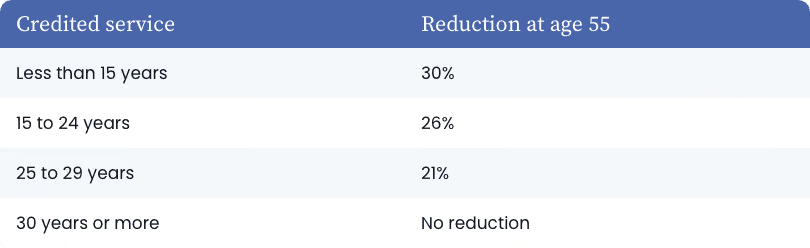
As you’ll see in the table above, Union employees with 30 or more years of credited service have no early-retirement reduction if they start benefits at age 55. Employees with at least 15 years can also get an unreduced benefit at age 62 under the published schedule.
Consider a hypothetical employee whose pension formula produces $3,000 monthly before early retirement and survivor-option adjustments. Starting at 55 with 20 years of credited service means a 26% reduction, bringing that amount to $2,220.
That reduction doesn’t suddenly disappear when the employee later turns 65. It reflects the age at which payments began. This is why the whole “Can I start?” and “Should I start?” conversations are drastically different.
Management and A&T have a different milestone
Final Average Pay participants can also start benefits after turning 55 and leaving pension-eligible employment. The difference is that their early retirement service bands aren’t the same as the Union ones.
At age 55, the Management manual lists:
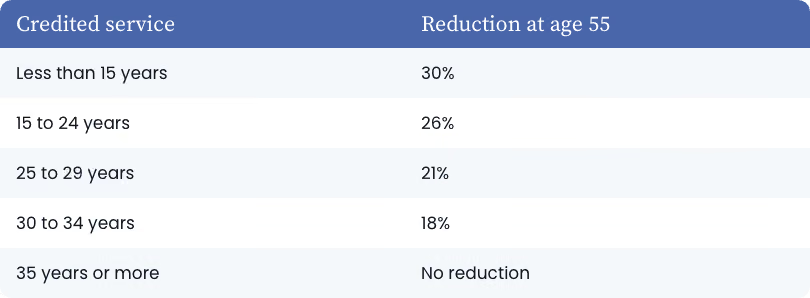
The main difference is the 35 years of credited service, not 30, to get an unreduced pension at age 55. With 30 to 34 years, Management participants can get an unreduced benefit at age 60, and with 15 to 29 years, they reach that point at age 62 under the schedule.
Say a Union employee and a Management employee are both 55 with 30 years of credited service. The Union employee has no early retirement reduction, while the Management employee has an 18% reduction. Both can start their pension, but the income picture looks different.
Leaving work and starting the pension are separate decisions
If you’re a vested legacy pension participant and you leave before 55, you can generally start payments once you turn 55. But leaving before 55 means the manuals don’t consider you a company retiree for other benefits, which are available to employees who leave at 55 or later.
Waiting to collect the pension doesn’t change the age you were when you left PG&E.
Medical coverage, retiree status, and any RMSA eligibility each need their own review, so don’t treat a pension vesting date as approval for every retirement benefit.
You can also leave at 55 or later and delay pension payments. The manuals illustrate someone leaving at 55 with 20 years of service: starting immediately carries a 26% reduction, starting at 60 carries 6%, and starting at 62 carries none.
Delaying requires another source of income, and you give up payments during the waiting period. It’s generally wise to compare both paths against your savings, health, household needs, and taxes rather than choosing solely by the largest monthly benefit.
Cash Balance offers earlier access after vesting
Cash Balance works differently. PG&E funds a pension account through pay credits and interest credits. It’s a pension benefit tracked as an account balance, not an investment account you manage yourself.
Once vested, you may be able to take the benefit after leaving PG&E at any age, without waiting all the way until 55. For example, a 48-year-old with three years of service can qualify for a Cash Balance distribution after employment ends.
Your choices include a lump sum, a monthly lifetime annuity, or delaying payment. Any benefit left in the plan keeps earning interest credits. The lump sum has no early-retirement reduction, though taking the money directly may trigger taxes and possible early-distribution penalties.
Getting access earlier also doesn’t mean you’ll have enough income to retire. Cash Balance annuity payments depend on your account value and the applicable conversion terms. Receiving a pension distribution before 55 isn’t the same as qualifying for company retiree benefits.
Employees with both Cash Balance and a frozen legacy pension make separate commencement elections. One benefit may be available while the other must wait.
Your 401(k) match depends on your group
PG&E’s Retirement Savings Plan match depends on your pension group and employee classification.
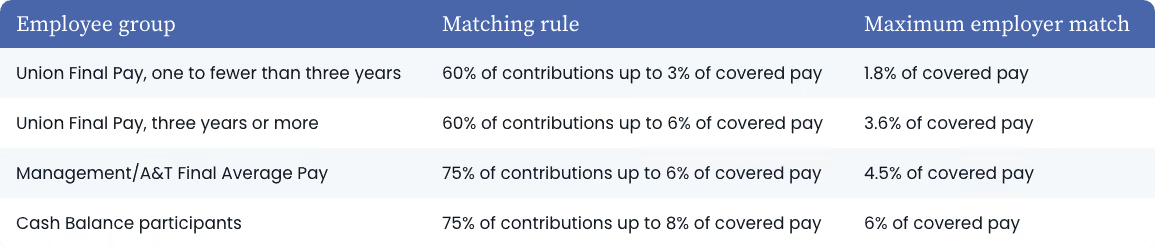
Union employees generally become match-eligible after 12 months of service. Management and A&T employees become eligible once they start contributing. Your own contributions, and any employer contributions credited to your account, are vested right away. Being eligible for the match and owning a credited match are two different things.
Matching occurs each pay period.
The manuals show how reaching your contribution limit early and stopping contributions can reduce the total match. A good idea is to pick your contribution rate with the full year in mind and review it whenever your pay changes.
Choose your retirement date with the whole picture in view
Before you settle on a date, confirm your pension type, vesting status, credited service, and retiree-benefit eligibility. Run pension estimates for several dates and compare the same payment option each time. Then look at those numbers alongside your 401(k), health coverage, taxes, and household spending.
The retirement rules tell you when benefits become available. Planning helps you decide when those benefits can support the life you want. The goal is to be more confident: knowing why your date works, what income covers it, and which decisions still need attention before your last day.
If you’re thinking about retiring from PG&E, you’re more than welcome to schedule some pressure-free time to talk. We can pull your pension choices, 401(k), taxes, and retirement income into one coordinated plan.
Based on PG&E’s 2026 Union and Management Summary Plan Descriptions. Individual eligibility and benefit amounts are subject to applicable plan terms and PG&E’s review. Tax treatment depends on your situation.
Powering Your Retirement is a Registered Investment Advisor. Registration as an investment adviser does not imply a certain level of skill or training, and the content of this communication has not been approved or verified by the United States Securities and Exchange Commission or by any state securities authority. The information contained in this material is intended to provide general information about Powering Your Retirement and its services. It is not intended to offer investment advice. Investment advice will only be given after a client engages our services by executing the appropriate investment services agreement.
You May Also Like,
Here are some must-read blogs you don’t want to miss! Get expert tips on retirement benefits, 401(k) management, and more. Stay in the know and make the most of your retirement planning!


Are You Ready for Retirement?
Book your free, no-strings-attached assessment—a stress-free process where we’ll tell you the exact amount you need to retire, when you want to!